A System Story
Agency: Huge
Role: Motion Director. Crystal development and system design.
Background
Apple Card pays you back in Daily Cash. The percentages, anywhere from 2% to double digits, are the whole pitch. They're the most valuable thing on the screen, and they were being treated like body copy. Apple needed the number to be the moment. Not a stat. A hero.

Problem
There was no system. Every offer got built one-off, its own layout, partner logos doing the heavy lifting, so nothing looked like it came from the same place. We wanted one element that was the program. Something Apple Card owned, that worked for every offer, not just the next email. That became Crystal.

Challenge
Crystal had to feel unmistakably Apple, built to mirror liquid glass, the design language Apple was rolling out across the OS, and it had to survive everywhere the program lives: web, email, DOOH. The catch: liquid glass that looks real is expensive to make and brutal to scale. At one point, the concept nearly got cut. We couldn't prove it would hold up across formats, and there was no fallback. It had to scale, or it was dead.


Approach
The crystal direction came down from creative leadership, and it almost died there. Liquid glass that looked real was expensive to make and brutal to scale, and nobody could prove it would hold up across formats. That proof became my job.
Early on, I used Firefly to pull visual reference: liquid-glass looks, number forms, objects to study while I shaped the approach. From there, the real problem was the refractions. To make the numbers read as real glass rather than a flat gradient, I rendered Apple's gradient background in C4D so the material would handle refraction and reflection in real 3D space. Built in After Effects, it looked like a sticker. Built in 3D, it looked like glass. That difference is the entire effect, and getting it repeatable took real R&D. Numerous tests, version after version, until it held up.
Then I turned the look into a system: corner radius, material behavior, motion, scale rules. Produced consistently instead of being hand-built every time. That's what solved the scalability problem that almost killed it, and what let Crystal ship clean across web, email, and DOOH.


Flat, it's a sticker. Refracted, it's glass. That difference was the job.


Results
Crystal became the hero treatment of Apple Card's engagement system, sitting alongside Aura and SF Symbols as one of its three core visual elements. The crystal material became the element the rest of the campaign was built around, deployed across web, email, and DOOH.
Apple wanted one program that looked like one program. Crystal is what made it look like that.

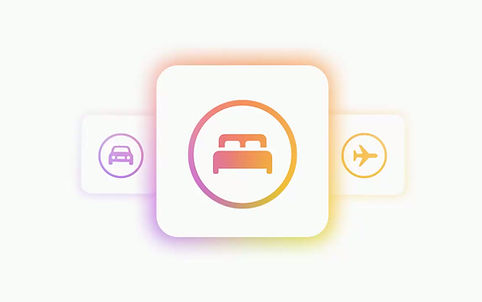
Crystal didn't ship alone. The team designed a partner icon system on the same logic, and I gave it the gradient treatment and the motion: scale, rotate, reveal, looping for email and web, where autoplay video can't go. Every new partner slotted into the same rules. The toolkit is still growing, new partners, new offers, built on the same system.



Still growing.